
The Edit: Ceremonies
Wedding Ceremony Ideas Built Around the Setting
Where the couple stands, which way guests face and what sits behind the vows: the ceremony is the moment the setting matters most. Ideas for layout, aisle and focal point across seven kinds of place.
A ceremony is usually brief, but it is the part of the day guests watch most closely and the part most often photographed. For those minutes, attention is fixed in one direction. What lies in that direction, and how guests are arranged to see it, decides much of how the ceremony feels.
Three decisions come before any decoration.
Three decisions first
- The focal point. What guests look at behind the couple. It can be a view, a doorway, a wall, a tree, an opening in a hedge. The strongest ceremonies choose something the place already has.
- The orientation. Which way everyone faces relative to the light. Guests facing low sun cannot see the couple, and a couple in full sun is lit harshly. Check the direction at the actual time.
- The aisle. Its length should suit the number of guests and the space. A long aisle through a small group feels empty. A short one in a large room feels abrupt.
When these three are right, the ceremony needs very little else. When they are wrong, decoration is usually being used to compensate.
The ceremony in seven settings
Garden
- Natural focal point
- An avenue, a hedge opening, a pair of trees, a view across lawn.
- Layout that suits it
- Rows on the garden's main axis, with the aisle along a path.
- Watch for
- Soft or damp ground, low sun, and too many hired structures.
Villa
- Natural focal point
- A terrace edge with a view, a loggia, a doorway, a stair.
- Layout that suits it
- A short, wide arrangement that fits the terrace's proportions.
- Watch for
- Limited space on terraces, and midday heat on stone.
Coast
- Natural focal point
- The horizon.
- Layout that suits it
- Guests facing the sea, with nothing taller than the view.
- Watch for
- Wind, glare and sound carrying away.
Mountain
- Natural focal point
- A valley, a peak, a line of trees.
- Layout that suits it
- A small group close together on level ground.
- Watch for
- Quick changes in weather, cool air and access for guests.
Barn
- Natural focal point
- The end wall, a large door open to the landscape, the timber frame.
- Layout that suits it
- A long aisle following the length of the building.
- Watch for
- Dim interiors in the day, and competing with the structure.
Greenhouse
- Natural focal point
- The end of the central axis, planting, the peak of the roof.
- Layout that suits it
- Rows along the length, the aisle down the center.
- Watch for
- Heat in sun, and the turnaround if dinner follows in the same room.
Courtyard
- Natural focal point
- A doorway, a well, a tree, a wall with climbing plants.
- Layout that suits it
- Guests close around the couple, sometimes on three sides.
- Watch for
- Shade falling early, and the courtyard's capacity.
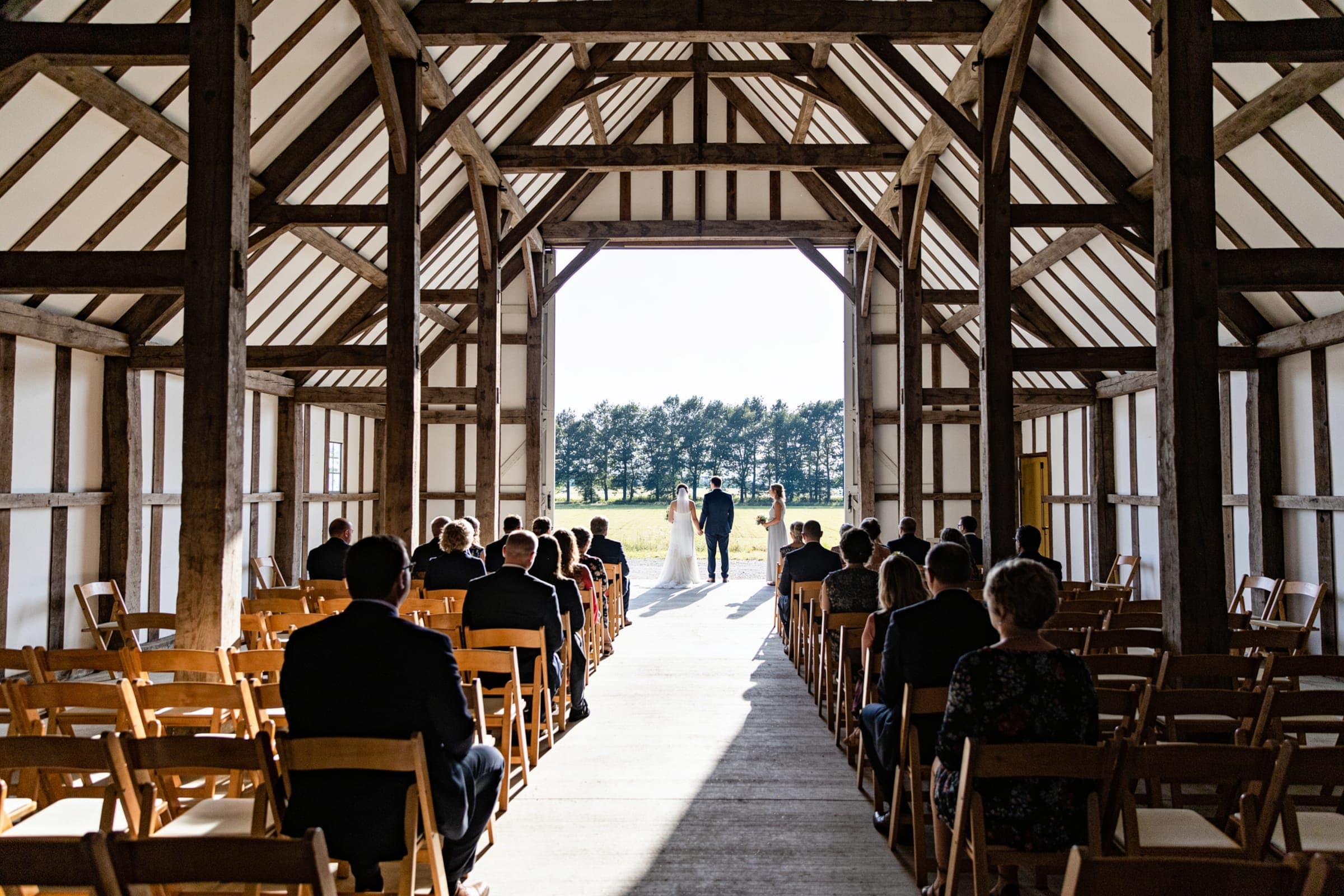
Seating, closer than you think
Straight rows facing forward are the default, but they are not the only option. Curved rows bring guests closer to the couple and let them see one another. Seating on both sides of a central space, facing inward, suits long narrow rooms and courtyards. Standing ceremonies work well for short services with small groups. For smaller guest lists, planning an intimate wedding ceremony looks at arrangement in more detail.
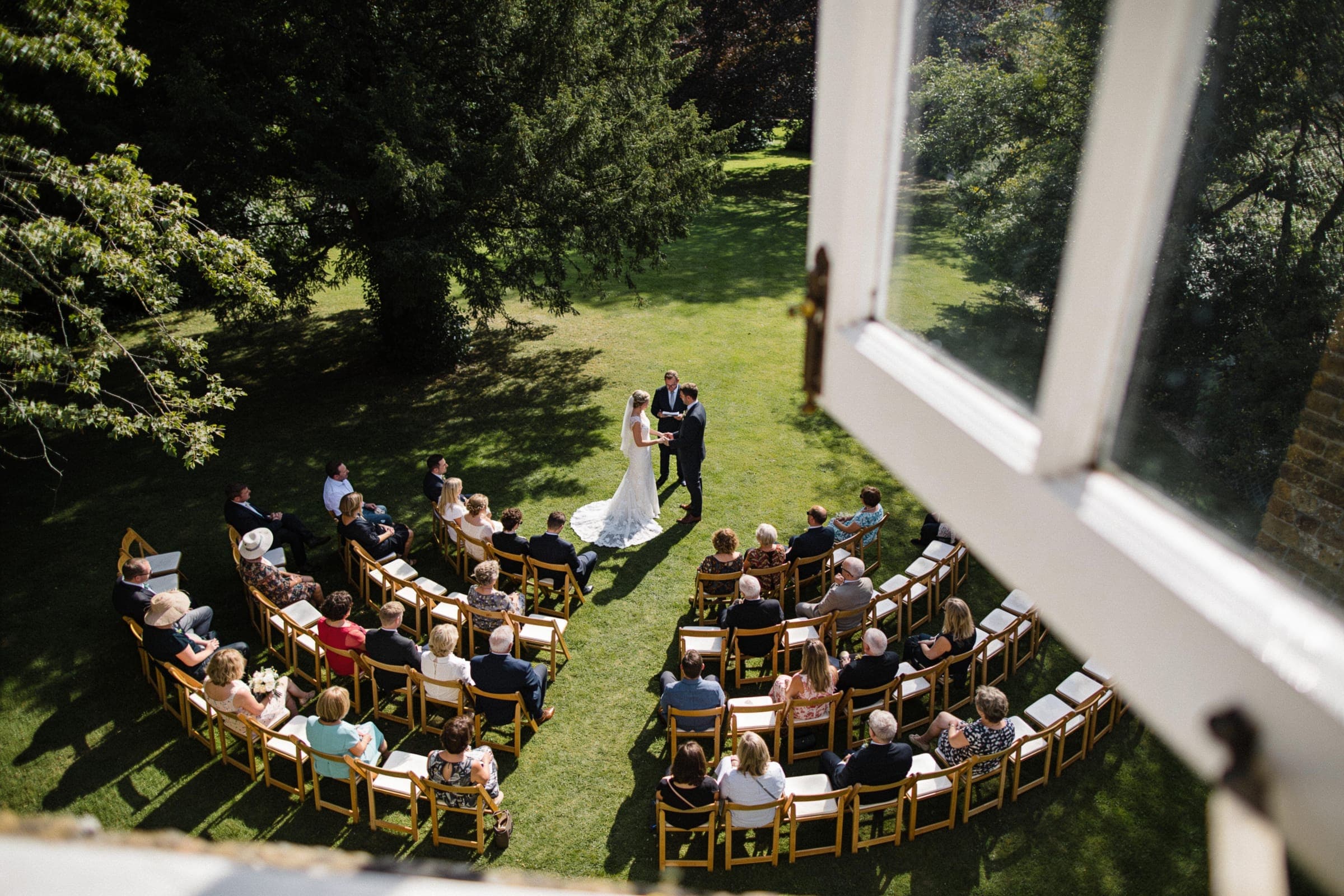
How much to add
Floral arches and structures can be useful where the setting lacks a focal point: a plain room, an open lawn, a marquee. Where the place already has one, they often block it. Arrangements at the ends of rows, or on the ground either side of the couple, frame the ceremony without hiding what is behind it. Wedding flowers that belong in the setting goes into scale and placement.
If the setting already frames the couple, a second frame usually competes with the first.
From ceremony to what comes next
Think about what guests do once the ceremony ends. If they walk to drinks elsewhere, the ceremony space can be arranged purely for the ceremony. If dinner follows in the same space, the layout has to allow a turnaround. How a reception room should work covers the arrangement that follows, and the garden and courtyard edit and the coastal edit look at the ceremony in those settings.